The general objective of the LIFE AFORCLIMATE project is to maintain and improve the efficiency of the beech forest ecosystem in the Apennines, through effective forest management that is adapted to climate change. To achieve this objective, the project will define a method for measuring likely impacts of climatic factors so as to manage beech forests in ways that promote forest regeneration and seed production and ensure resilience. The project aims to achieve biomass increases (and therefore CO2 sequestration) of 5-7% to 15-20% compared to the reference value deriving from the application of the traditional approach. This will also increase overall ecosystem functionality. The project expects to achieve the following results:
To make forest management in the project areas actions consistent with adaptation to climate change;
To create a detailed forecast model for forestry management that takes climate change variability into account;
To develop a monitoring scheme to assess, by the end of the project, the impacts of the approach to forest management in terms of regeneration capacity, production capacity and biodiversity. This scheme will take into consideration the entire ecosystem of beech forest and all components essential for appropriate forest management; and
To develop an extensive information campaign complying with the second objective of the EU Strategy on adaptation to climate change: “promoting better informed decision-making by addressing gaps in knowledge about adaptation and further developing the European Climate Adaptation Platform (Climate-ADAPT) as the ‘one-stop shop’ for adaptation information in Europe”.
The Special Issue provides an overview on Forest Management Decision Support Systems currently designed and applied for the sustained provision of ecosystem services within the context of climate change based on the presentations given at the 24th World Congress of the International Union of Forest Research Organizations (IUFRO). The contributions demonstrate an overview on models, methods, techniques used in decision support and the proposed frameworks to support decision making. In this Special Issue, four different spatial decision support approaches allow reviewing the state of art in considering spatial and temporal dimensions in forest management planning.
Firstly Reynolds et al. (2014) discuss, in their review, the design features behind the success of the Ecosystem Management Decision Support System (EMDS) and propose the needs for the next generation of spatial decision support for adaptive management under climate change. Generality, transparency, simplification, abstraction and complexity, as well as the consideration of the spatial scale have been identified as critical for the success of the EMDS system, and deserve careful consideration in the design of decision-support systems for natural resource management. Following this recommendations, Frank et al. (2015) demonstrate the platform GISCAME to model spatio-temporal dynamics of biomass production at a regional scale in order to identify land use strategies that enhance biomass provision and avoid trade-offs for other ecosystem services. The results showed that forest conversion towards climate-change-adapted forest types had positive effects on ecological integrity and landscape aesthetics. Marušák et al. (2015) introduce the GIS tool Optimal for supporting spatial and temporal decisions in harvest scheduling. The DSS is designed and applied for silvicultural systems comprising clear-cuts and shelterwood systems with respect to the environmental and economic constraints. Forest managers are enabled to create and check spatial limits of harvest units and create various scenarios with Optimal. Daleman et al. (2015) introduce the concept, characteristics, functionalities, components and use of the Sim4Tree DSS, which supports strategic and tactical forestry planning by providing simulations of forest development, ecosystem services potential and economic performance through time, from a regional to a stand scale, under various management and climate regimes. Finally, Biber et al. (2015) compiled scenario runs from regionally tailored forest growth models and DSS from 20 case studies throughout Europe and analyzed whether the ecosystem service provision depends on management intensity and other co-variables, comprising regional affiliation, social environment, and tree species composition. They found a strong positive correlation between management intensity and wood production, but only weak correlation with protective and socioeconomic forest functions.
In addition to the presentation of various DSS, several advances in decision support techniques were identified, ranging from multi-attribute to multi-objective decision making methods. Garcia-Gonzalo et al. (2015) demonstrate the integration of an Interactive Decision Maps (IDM) technique within a DSS for an interactive visualization of the Pareto frontier. The multi-objective forest planning scenario of 1 million ha of cork and holm oak forest ecosystems in Southern Portugal is facilitated by stakeholder participation. Kašpar et al. (2015) present an approach where multiple criteria programming and integer programming techniques are used to find an optimal program of forest harvesting with respect to both economic and environmental constraints. Aldea et al. (2014) propose a goal programming procedure for integrating ecosystem services into forest management including a deterministic and a Monte Carlo modeling approach. Similar to other authors they highlight the variability of the results depending on the methodological approach taken and propose to critically evaluate the methodological approach taken. In this context also Estrella et al. (2014) introduced three different ideal point-based multi-criteria decision methods, i.e., iterative ideal point thresholding (IIPT), compromise programming (CP) and balanced compromise programming (BCP) to find an optimal distribution of land use types for regional land performance. For most ecosystem service analyzed, CP and BCP produced balanced results that were closer to the absolute optimal values when compared to IIPT. From the wide field of multi-criteria decision making techniques, Mendoza et al. (2015) compare different forest management schemes of Mexico in order to identify best management approaches considering multi-resources, environmental impacts and non-timber values. Considering the increased need for the involvement of preferences of decision makers, Rinaldi et al. (2015) provide an example of how forest owner specific characterization can be integrated in a DSS by linking a behavioral harvesting decision model to a forest resource dynamics model. They showed that the distribution of different owner types on forestland affects harvesting intensity and inter-temporal forest development. In the work of Nobre et al (2016) the material produced in the context of the COST Action FORSYS was used to generate quantitative summaries of (i) the types of problem where FMDSS are used, (ii) models and methods used to solve these problems, (iii) knowledge management techniques, and (iv) participatory planning techniques.
The Editorial of the Special Issue highlight that the development in decision support for forest management is set by decision theory, available technology, and methods. In addition to the technological and methodological advances, there is a strong need to include decision makers and DSS users in the design of the DSS from the very beginning in order to better meet their demands.
The Swedish University of Agricultural Sciences (SLU) is searching for an Associate Senior Lecturer in forest management with a focus on adaptation of forestry to climate change
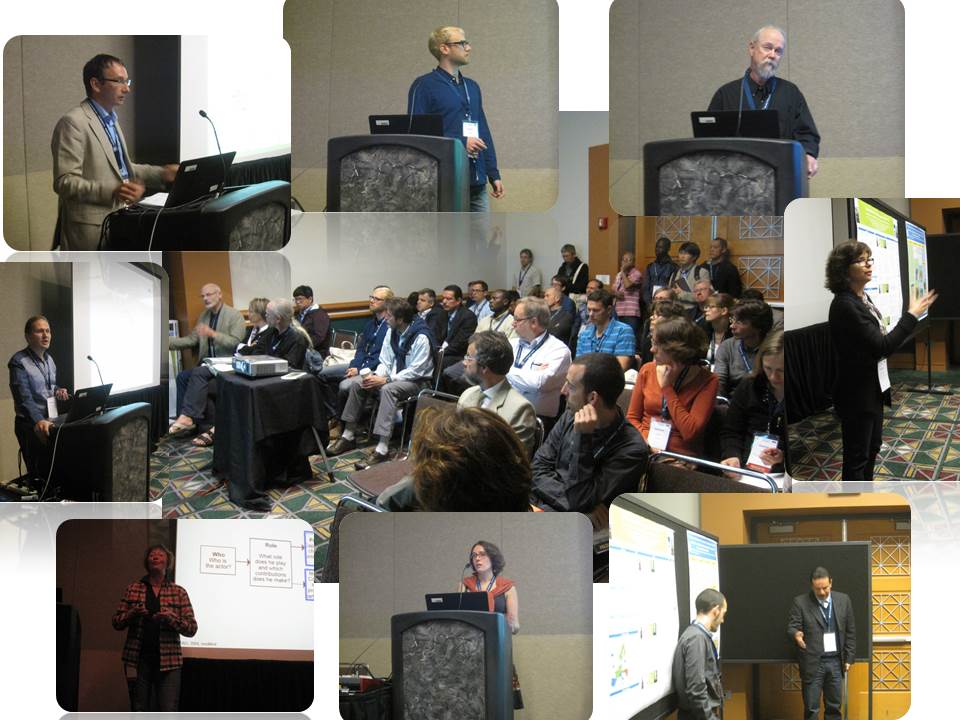
During the IUFRO Congress in Salt Lake City a session explored how Decision Support Systems (DSS) are currently designed and applied for a sustained provision of ecosystem services under climate change, ranging from examples in the US and Europe, focusing on different contexts. The presenters provided an overview about the different models, methods and techniques applied to support decision making under changing environmental conditions and the challenges they have to tackle in tailoring the DSS to the needs of the decision makers. The following conclusions were drawn in the discussion:
- there is a strong need for DSS to consider growth models and ecosystem models that are capable in addressing changing environmental conditions, include biotic and abiotic disturbance agents and allow an evaluation for multiple ecosystem services
- DSS should provide frameworks that allow considering uncertainties in decision making and provide possibilities for risk evaluation
- There is a strong need to include decision makers and DSS users in the design of the DSS from the very beginning in order to meet their demands
- DSS allow to increase transparency of decision making processes, support formal evaluation of decision alternatives and allow to include various stakeholders and actors in decision making
- There is a dilemma in addressing all aspects of the complex decision making contexts in forest management but still trying to design simple applications according to the user demands
- The members of the Community of Practice on Forest Decision Support Systems (www.forestdss.org) should continue to share their expertise in applying models, methods, techniques and frameworks for developing and applying DSSs to provide lessons learned
The oral and poster presentations given in the session, can be found as an attachment here:
Oral Presentations:
Harald Vacik & Sean Gordon: Community Of Practice Of Forest Management Decision Support Systems And Lessons Learned For DSS Development And Application
Keith Reynolds: Design Features Behind The Success Of The Ecosystem Management Decision Support System
Antti Mäkinen: Long-Term Forest Planning Under Risk And Uncertainty; Can Robust Linear Programming Help?
Poster Presentations:
Robert Marusak: DSS Optimal - A Case Study Form The Czech Republic
Jan Kaspar: Spatial Aspects Of Biodiversity As A Part Of Harvest Scheduling Decision Process
Aleš Poljanec : Balancing Biomass And Biodiversity In Protected Areas, The Triglav National Park Case Study
Susana Barreiro: Evaluating Future Wood Availability In Europe. Methods And Tools
Francisco Dominguez Hernandez: The System Of Silviculture For Conservation And Development (SICODESI), Lessons From A Successful Case Of Forest Management In Jalisco, México
It is intended to produce a special issue for the Journal Forests of all presentations given during the session and some invited additional contributions that are coming from the field of DSS. The papers will be published under open access and will be peer reviewed. For further information please refer to